Image courtesy of the Oregon Department of Transportation’s ‘Get There Oregon’ program
Current bill status as of February 26, 2026: HB661 was filed by Delegate Rodney Willett (D, HD-58) on January 13, and the House of Delegates passed it unanimously (98Y-0N-0A) on February 9. On February 26, HB661 was reported 13Y-1N by the Senate Transportation Committee and re-referred to the Senate Finance and Appropriations Committee.
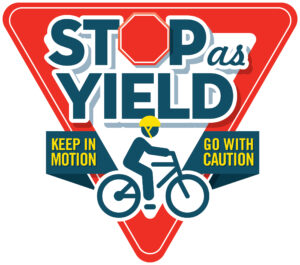
One of the most impactful, proven bicyclist safety policies Virginia can enact in 2026 is the Bicyclist’s Safety Yield (also known as the “Safety Stop”). The Safety Yield allows people bicycling to treat stop signs as yield signs when the way is clear—a change shown to reduce crashes and save lives.
The Safety Yield is one of three measures included in an Omnibus Bicyclist Safety bill that the Virginia Bicycling Federation (VBF) has been teeing up for the 2026 Virginia General Assembly session, which begins January 14.
Take action: Read this post and share it to help build understanding and support for the Bicyclist’s Safety Yield in Virginia.
What’s The Problem?
Virginia’s current law creates unnecessary risk at intersections for people bicycling. Currently, a bicyclist must come to a complete stop at every stop sign. This requirement:
- Slows progress through intersections—where nearly two-thirds of all bicycle-vehicle crashes occur¹. Because bicycle riders must restart from a dead stop, it takes them longer to cross the intersection and necessitates longer gaps in the cross-traffic to clear the intersection safely.
- Keeps bicyclists in conflict zones longer than necessary–both before entering and while crossing the intersection.
- Frequently restarting from a full stop discourages bicycling on low-traffic, low-speed local streets, which are generally safer for bicycling than busier roads.
- Reduces an inexperienced bicyclist’s stability when restarting from a dead stop, which could cause them to fall at the intersection.
National safety experts, including the National Highway Traffic Safety Administration (NHTSA), recognize the Safety Yield as a proven safety measure.²
In 2021, the Virginia State Police convened a stakeholder work group to study the Safety Yield. The group reached consensus findings, but Virginia law has not yet been updated to reflect them.
How Does The Safety Yield Improve Safety?
The Safety Yield does not change right-of-way rules or eliminate yielding—it requires bicyclists to slow, look, and yield the right-of-way where appropriate.
What it changes is this: When no vehicles or pedestrians are present or approaching, a bicyclist may proceed through a stop-sign-controlled intersection without coming to a full stop. This allows the rider to:
- Maintain momentum
- Clear intersections more quickly
- Reduce exposure to moving traffic
Starting from a complete stop requires a larger gap in cross-traffic, increasing risk. The Safety Yield reduces that risk.
📺 This short video explains how the Safety Yield works: Idaho “Rolling” Stops for Bicycles (2009)
What Has The Research Shown?
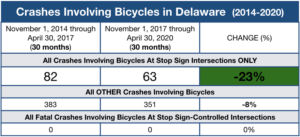
Idaho vs. California: Research by Jason Meggs (UC Berkeley School of Public Health) found Boise had at least 30% fewer bicycle injuries than comparable Sacramento.
Are There Other Benefits?
Yes. The Safety Yield encourages bicycling on lower-traffic neighborhood streets with frequent stop signs rather than less-safe alternatives.
Shouldn’t Bicyclists Always Follow The Rules For Motor Vehicles?
- Stop signs are installed by traffic engineers to control the movement and speed of motor vehicles, which are much heavier, more powerful, and typically faster than bicycles.
- Because bicyclists are not inside a vehicle and approach intersections more slowly than motorists, they can often readily see and hear any approaching traffic before reaching the intersection and without fully stopping.
- As exposed, vulnerable road users, most adult bicyclists are highly risk averse and actively seek to avoid collisions.
- The Safety Yield does not change the right-of-way rules at stop signs and conforms the law to how many bike riders already behave at most stop signs when no vehicular or pedestrian cross-traffic is present. Moreover, the Safety Yield is merely permissive, not prescriptive.
Has The Safety Yield Been Adopted Elsewhere?
Yes. Idaho enacted the Safety Yield in 1982, and it has since been adopted by 10 other states: Delaware, Arkansas, Oregon, Washington, Utah, North Dakota, Oklahoma, Colorado, Minnesota, New Mexico…and the District of Columbia.
Moreover, no state has ever repealed the Safety Yield after adopting it.
Does The Safety Yield Allow Bicyclists to Blow Red Lights?
No. Although Idaho and several other states do allow bicyclists to treat red traffic lights as stop signs, we are not proposing any such measure for Virginia. Our proposed law does not allow any reckless behavior.
- Bicyclists must still stop–and remain stopped–at red lights.
- Bicyclists must still approach intersections slowly and yield to pedestrians and vehicles with the right-of-way.
Has Virginia Considered This Before?
Yes. In 2021, the Virginia House of Delegates passed a Bicyclist Safety Act (HB2262), which included the Safety Yield, by a vote of 75-24. The Safety Yield provision was ultimately referred to the Virginia State Police for further study with input from diverse stakeholders.
What Did The Virginia State Police (VSP) Study Conclude?
Our proposed legislation for 2026 reflects the stakeholder consensus from that VSP study:
- The bill will duplicate Delaware’s proven model. The Safety Yield would be allowed only at intersections of two-lane or narrower roadways.
- The Safety Yield would not apply to bicyclists under age 15, addressing concerns about cognitive development raised by the AAA.
The Bottom Line:
Enacting the Safety Yield in Virginia could save lives every year, while also supporting public health, environmental sustainability, and safer communities.
📣 Please share this article to help build support for safer streets in 2026.
Questions or comments? Contact the VBF Advocacy Committee at 📧 vbfadvocacycommittee@gmail.com
Footnotes:
[1] Safety Research Report: Bicyclist Safety on US Roadways: Crash Risks and Countermeasures, National Transportation Safety Board, Adopted November 5, 2019. Page 27.
[2] NHTSA’s Bicyclist “Stop-As-Yield” Laws and Safety Fact Sheet, March 2022, accessed 12/16/2025.
About the Virginia Bicycling Federation
The Virginia Bicycling Federation works to make Virginia the most bicycle-friendly state in the nation. Through advocacy, education, and community partnerships, we promote safe, accessible, and enjoyable bicycling for people of all ages and abilities. From historic trails to vibrant downtowns, bicycling connects us to our communities—and to Virginia’s rich past and promising future. Learn more at www.vabike.org.
This article was drafted by VBF board members Jim Durham, Jenn Million, and Susan Motley.