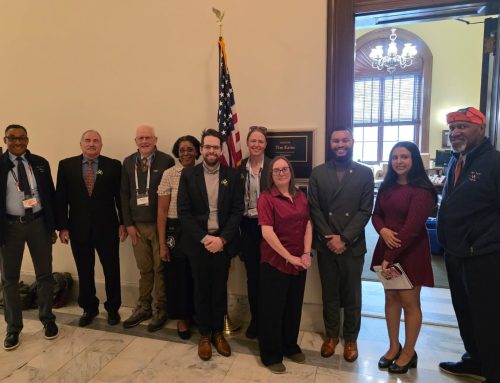

A parent alongside students riding to school in Alexandria, VA. Photo courtesy of Jim Durham.
Current bill status as of February 26, 2026: HB661 was filed by Delegate Rodney Willett (D, HD-58) on January 13, and the House of Delegates passed it unanimously (98Y-0N-0A) on February 9. On February 26, HB661 was reported 13Y-1N by the Senate Transportation Committee and re-referred to the Senate Finance and Appropriations Committee.
Virginia’s current law around riding two abreast creates unnecessary risk for people bicycling — especially families and less-experienced riders. Research shows that riding two abreast is often safer than riding single file, yet Virginia law restricts it in ways that are unclear and difficult to follow.
As written, it can be illegal for a parent to ride next to their child on a neighborhood street when a faster-moving vehicle approaches from behind. This creates confusion, discourages safe riding practices, and puts people in harm’s way.
Virginia’s “riding two abreast” language is also out of step with the clearer, simpler standards used by most other states.
Allowing riding two abreast on low-speed roads, while clearly defining when it may be limited on higher-speed, two-lane roads, would improve safety and make the law easier for everyone — bicyclists and drivers alike — to understand.
Riding two abreast is one of three measures in the Omnibus Bicyclist Safety bill that the Virginia Bicycling Federation (VBF) is preparing for the 2026 General Assembly session, which starts on January 14.
Take action: Read this post and share it to help build understanding and support for safer bicycling laws in Virginia.
What’s the Problem?
Virginia’s current law is ambiguous and creates unnecessary risk for people bicycling. In practice, it can prevent parents, caregivers, or experienced riders from riding next to children or less-experienced riders on neighborhood streets — even when doing so would be safer.
This lack of clarity forces bicyclists into single file in situations where riding side by side would improve visibility and safety.
How Does Riding Two Abreast Improve Safety?
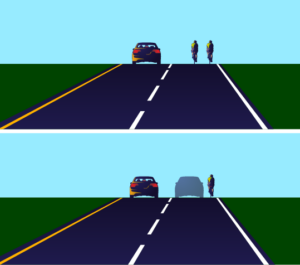
Image courtesy of BikeWalk NC. Artwork by Keri Caffrey.
Increases visibility
Riding two abreast makes people on bicycles more visible to drivers approaching from behind and from the opposite direction.
Improves perception of position and passing space
Riding side by side helps drivers better judge where bicyclists are in the lane and whether there is enough space to pass safely without changing lanes.
Discourages unsafe passing
Riding two abreast reduces the likelihood that drivers will attempt to squeeze past bicyclists in the same lane when there is not enough room to overtake safely without changing lanes.
Are There Other Benefits?
Yes. Allowing riding two abreast makes it easier for parents and caregivers to ride alongside children and less-experienced riders on neighborhood streets, offering guidance, communication, and reassurance where it matters most.
Riding two abreast shortens the length of the cycling group, making it quicker and easier for drivers to pass safely, by changing lanes when conditions allow.
What Has the Research Shown?
- A 2020 North Carolina legislative study concluded that riding two abreast is safer than riding single file and recommended no state restrictions on two-abreast bicycling.
- A 2020 Australian study found that riding two abreast in a traffic lane reduced risk for cyclists.
- A 2021 study in Spain found higher compliance with safe passing distances when cyclists rode two abreast.
Has Riding Two Abreast Been Adopted Elsewhere?
Yes.
- Twenty-six states have no restrictions on riding two abreast on roadways.
- Twenty-one states, including Virginia, allow riding two abreast on roadways when not impeding traffic. Most of these states use clear language recommended by the Uniform Vehicle Code; namely, “Persons riding two abreast shall not impede the normal and reasonable movement of traffic.“
Would Proposed Language Allow Bicycling Groups on Faster Roads to Impede Traffic?
No. On two-lane roadways with posted speed limits above 30 MPH, two-abreast bicyclists would still be prohibited from impeding “the normal and reasonable movement of traffic”. Most bicyclists actively cooperate with motor traffic to share the road safely.
The Bottom Line
The Omnibus Bicyclist Safety bill is a commonsense, safety-focused update that will reduce crashes involving bicyclists, support family and community riding, and bring Virginia law in line with proven national best practices.
Please share this article to help build support for safer streets in 2026.
Questions or comments?
Contact the VBF Advocacy Committee at 703-508-0762 or vbfadvocacycommittee@gmail.com
About the Virginia Bicycling Federation
The Virginia Bicycling Federation works to make Virginia the most bicycle-friendly state in the nation. Through advocacy, education, and community partnerships, we promote safe, accessible, and enjoyable bicycling for people of all ages and abilities. From historic trails to vibrant downtowns, bicycling connects us to our communities—and to Virginia’s rich past and promising future. Learn more at www.vabike.org.
This article was drafted by VBF board members Jenn Million and Jim Durham.