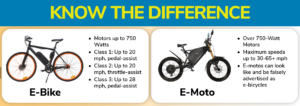
Graphic from Arlington County, VA: Vision Zero Public Engagement Toolbox: E-Motos
E-bikes are helping more Virginians ride for transportation, fitness, and fun. But many electric devices sold as “e-bikes” are really electric motorcycles, often called e-motos, that go well beyond the limits for legal e-bikes. With the holiday buying season here, and many families shopping for teenagers, now is the time to know the difference.
This post explains how to tell a legal e-bike from an e-moto, what the Virginia Bicycling Federation (VBF) has been doing on this issue, and how you can help make Virginia’s streets and trails safer for everyone.
Know the Difference Before You Buy
Under Virginia law, a legal e-bike has working pedals and a motor of 750 watts or less, and goes no more than 20 mph on motor power alone. A Class 3 e-bike can assist up to 28 mph only while the rider pedals. Manufacturers must label every e-bike with its class, top assisted speed, and motor wattage.
A device is not a legal e-bike if it:
- Has no working pedals
- Has a motor over 750 watts
- Goes faster than 20 mph on motor power alone, without pedaling
- Has a higher-speed “off-road” or “unlimited” mode, even if it also has a “street” mode, or can be unlocked to exceed these limits
- Has no label showing its class, top assisted speed, and motor wattage
These devices are e-motos, whatever the seller calls them. Most don’t meet federal motor vehicle safety standards for brakes and lights. They can’t legally be ridden on public roads unless registered as a moped or motorcycle, and they don’t belong in bike lanes, on sidewalks, or on multiuse paths.
Please share the poster below with friends and family, especially anyone shopping for a teenager this holiday season. Our ‘Know the Difference’ poster below sums it up on one page.
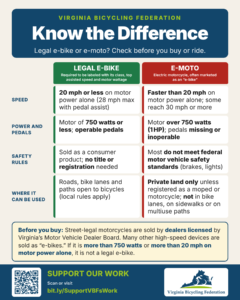
VBF’s poster to distinguish between lawful e-bikes and problematic e-motos
VBF’s Work on the HB1120 Micromobility Workgroup
In 2026, the General Assembly passed HB1120, directing the Virginia Department of Motor Vehicles (DMV) to study e-bikes and other micromobility devices and recommend measures to improve safety. VBF served on the stakeholder workgroup that DMV convened. We submitted recommendations grounded in data and research from other states, commented on DMV’s proposed final report, and provided feedback on proposed legislation.
Thank you to Delegate JJ Singh for his leadership as patron of HB1120, to DMV staff for leading a thorough and inclusive process, and to fellow stakeholders for their constructive participation. Many of DMV’s recommendations reflect VBF’s priorities, including maintaining Virginia’s three e-bike classes, improving crash data collection, expanding public education, and investigating misleading advertising by sellers.
We look forward to seeing thoughtful legislation that improves micromobility safety during the 2027 General Assembly session, which convenes January 13.
What VBF Is Asking the General Assembly To Do
- Draw a clear line on what is not an e-bike. Regulate devices that go more than 20 mph and up to 35 mph on motor power alone similarly to mopeds, including meeting federal motor vehicle safety standards for brakes, lights, and tires appropriate for 35 mph speeds, and carrying the manufacturer’s label certifying they meet those standards. Regulate faster devices as motorcycles. Clear classification would also help the Virginia Attorney General’s office hold sellers accountable for misleading advertising.
- Pass Delegate Willett’s Bicyclist Safety Bill. Improving safety also means addressing how bicyclists navigate intersections. The bill’s safety yield, law in 12 states and D.C., lets people biking treat stop signs as yield signs. In Delaware, it cut bicyclist crashes at stop-sign intersections by 23%.
Education first, not enforcement against individual riders. The most effective safety measures reach people before a crash. VBF supports public education for riders and parents and holding sellers accountable for mislabeled devices, rather than relying on police to stop teenagers and other riders on the street. One action against a misleading seller reaches every device it sells; one traffic stop reaches one rider.
How You Can Help
- Share the ‘Know the Difference’ poster with friends, family, your school community, and your local bike shop.
- Stay informed. Follow VBF’s legislative updates and action alerts as we work toward safer streets and clearer e-bike and e-moto regulations in the 2027 General Assembly session (signup links below).
- Support VBF’s work. VBF is an all-volunteer 501(c)(3) nonprofit promoting bicycling and bicycling safety in Virginia. Join, donate, or sign up to stay informed at bit.ly/SupportVBFsWork.
Thank you for helping make Virginia’s streets and trails safer for everyone. Join VBF now and save 50% on membership with discount code 2027Progress at bit.ly/SupportVBFsWork.


Leave A Comment